
1. INTRODUCTION
- Employee Stock Option Plans, commonly known as ESOPs, are no longer just a paper promise given to employees at the time of hiring. In 2026, several Indian startups have shown that ESOPs can become a real wealth-creation tool for the employees when companies provide structured liquidity opportunities through ESOP buybacks.
- The first quarter of 2026 saw a strong wave of ESOP buybacks across SaaS, healthtech, fintech, Web3 and edtech companies. These transactions were not merely employee reward exercises. They reflected a deeper shift in how Indian startups are viewing employee ownership, retention, morale, and long-term value sharing.
From BrowserStack’s large $125 million ESOP buyback to Innovaccer’s $75 million liquidity event and CoinDCX’s $12 million ESOP buyback, the trend clearly shows that mature startups are using ESOP liquidity as a strategic business tool, not just a compensation benefit.
2. ESOP BUYBACK TIMELINE: KEY STARTUP TRANSACTIONS
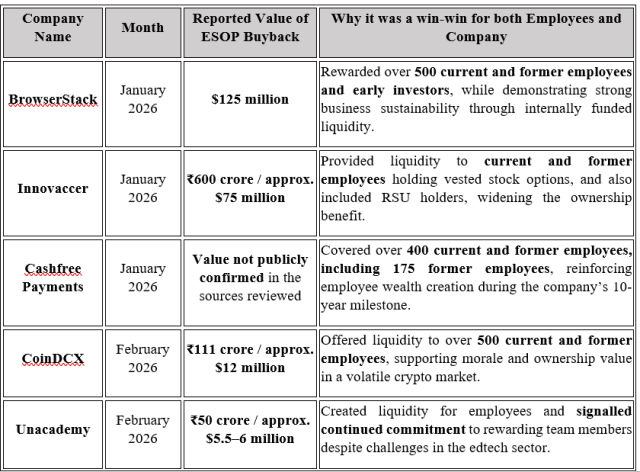
3. WHAT MAKES THESE ESOP BUYBACKS IMPORTANT?
A. ESOPs Are Becoming Real Wealth
ESOPs are no longer just a future promise linked to an IPO or acquisition. The market trend of ESOP Buyback in 2026 shows that startups are creating interim liquidity opportunities, allowing employees to convert their notional ESOP value into real financial gains.
B. BrowserStack Showed Profitable Growth
BrowserStack’s $125 million buyback rewarded over 500 current and former employees and early investors. Since it was funded through internal accruals, it reflected the company’s financial strength and showed that sustainable businesses can create employee wealth even before an IPO.
C. Innovaccer Expanded Ownership Culture
Innovaccer’s ₹600 crore ESOP buyback provided liquidity to current and former employees and also covered RSU holders. This widened the benefit of ownership and showed that equity rewards can go beyond senior leadership to create a broader ownership culture.
D. Cashfree Rewarded Long-Term Contribution
Cashfree’s ESOP buyback covered over 400 employees, including 175 former employees. By including former employees, the company recognised past contributions and strengthened its employer brand.
E. CoinDCX Boosted Employee Confidence
CoinDCX’s ₹111 crore buyback helped over 500 current and former employees realise value from their vested options. In a volatile crypto market, this acted as a strong morale booster and reinforced trust in the company.
F. Unacademy Reinforced Trust During Sector Pressure
Unacademy’s ₹50 crore ESOP buyback showed that even in challenging sectors like edtech, companies can use ESOP liquidity to reward employees, maintain confidence and protect the value of equity compensation.
4. MOVING BEYOND THE “WAIT FOR EXIT” APPROACH
- Earlier, employees often expected ESOP value only at the time of IPO or acquisition. However, the market trend of ESOP buyback in 2026 shows that companies are creating internal or secondary exit opportunities even before a public listing – This is a major shift.
- It means that startups are beginning to treat ESOP liquidity as a planned lifecycle event rather than an accidental outcome.
- This also helps companies to manage employee’s expectations in a better manner. When employees are aware that the company has a structured liquidity philosophy, they are more likely to trust the ESOP programme.
5. WHY ESOP BUYBACKS ARE A WIN-WIN FOR COMPANIES AND EMPLOYEES
1. For Employees
- ESOP buybacks help employees to convert paper wealth into real money. This creates financial confidence among employees and validates the value of their contribution.
- It also makes employees more connected to the company’s growth journey because they can see that ownership has practical value.
2. For Companies
- ESOP buybacks improve retention, motivation and employer reputation. They also help in building a strong ownership culture within the organization.
- A well-managed buyback can show investors, employees and the stakeholders that the company is serious about governance, transparency and long-term wealth sharing.
3. For Founders
- ESOP liquidity helps build trust. It shows that the leadership is not only focused on valuation, funding or investor returns, but also on rewarding the team that helped build the business.
6. KEY LESSONS FOR STARTUPS PLANNING ESOP BUYBACKS
A. ESOP Liquidity Should Be Planned Early
Companies should not wait for employee’s dissatisfaction before planning liquidity. ESOP buybacks should be part of a long-term compensation and ownership strategy.
B. Communication Matters
Employees must clearly understand eligibility, vesting, exercise, tax impact and ESOP buyback mechanics. Poor or lack of communication can reduce the impact of even a good ESOP buyback programme.
C. Compliance Cannot Be Overlooked
ESOP buybacks involve legal, taxation, accounting, FEMA and corporate law domains considerations depending on the company structure and geographical location of employee. A poorly structured ESOP buyback may result in avoidable regulatory exposure and adverse tax complications, underscoring the need for careful planning and execution.
D. Former Employees Should Not Be Overlooked
In 2026, many ESOP buybacks included former employees. This is a positive trend because it recognises historical contribution and improves the company’s reputation in the talent market.
E. ESOPs Need Technology-Backed Governance
As companies scale, reliance on manual ESOP tracking becomes risky and prone to errors. It is therefore essential to adopt proper ESOP administration platforms to effectively manage grants, vesting, exercise, cancellations, liquidity events, employee communication and reporting.
7. THE ROAD AHEAD: ESOP BUYBACKS WILL BECOME MORE STRATEGIC
- The 2026 ESOP buyback trend shows that Indian startups are maturing. Companies are now looking beyond valuation headlines and focusing on sustainable wealth creation for the employees of the organization.
- Going forward, ESOP buybacks are likely to become more structured, more frequent and more closely linked with following practices:
- funding rounds
- secondary transactions
- pre-IPO preparation
- employee retention plans
- leadership reward programmes
- cap table clean-up
- long-term ownership culture
3. For startups, ESOPs will no longer be just a hiring tool. They will become a governance, compensation and wealth-sharing instrument.
Conclusion:
The ESOP buybacks by BrowserStack, Innovaccer, Cashfree, CoinDCX and Unacademy in 2026 show a clear shift in India’s startup ecosystem. Employee ownership is becoming more meaningful, more liquid and more strategic.
These buybacks created a win-win outcome for both employees and Company. Employees received real financial value, while companies strengthened trust, loyalty and long-term ownership culture.
For Indian startups, the message is clear: ESOPs work best when they are not just granted, but also governed, communicated and monetised properly.
A well-designed ESOP plan, supported by strong compliance and technology, can become one of the most powerful tools for employee wealth creation and business growth.
